LLC business taxesSort the notice before you pay
An LLC can owe the IRS, a state, a payroll agency, and a sales tax office, and they do not share a calendar. Steven Palmieri, a Tax CFO and the Entrepreneur's CFO, reads that mail on this address, closes the month before anything else, and only then places payroll on a provider you run or writes the return from that month.

Which paper arrived
The Tax CFO way
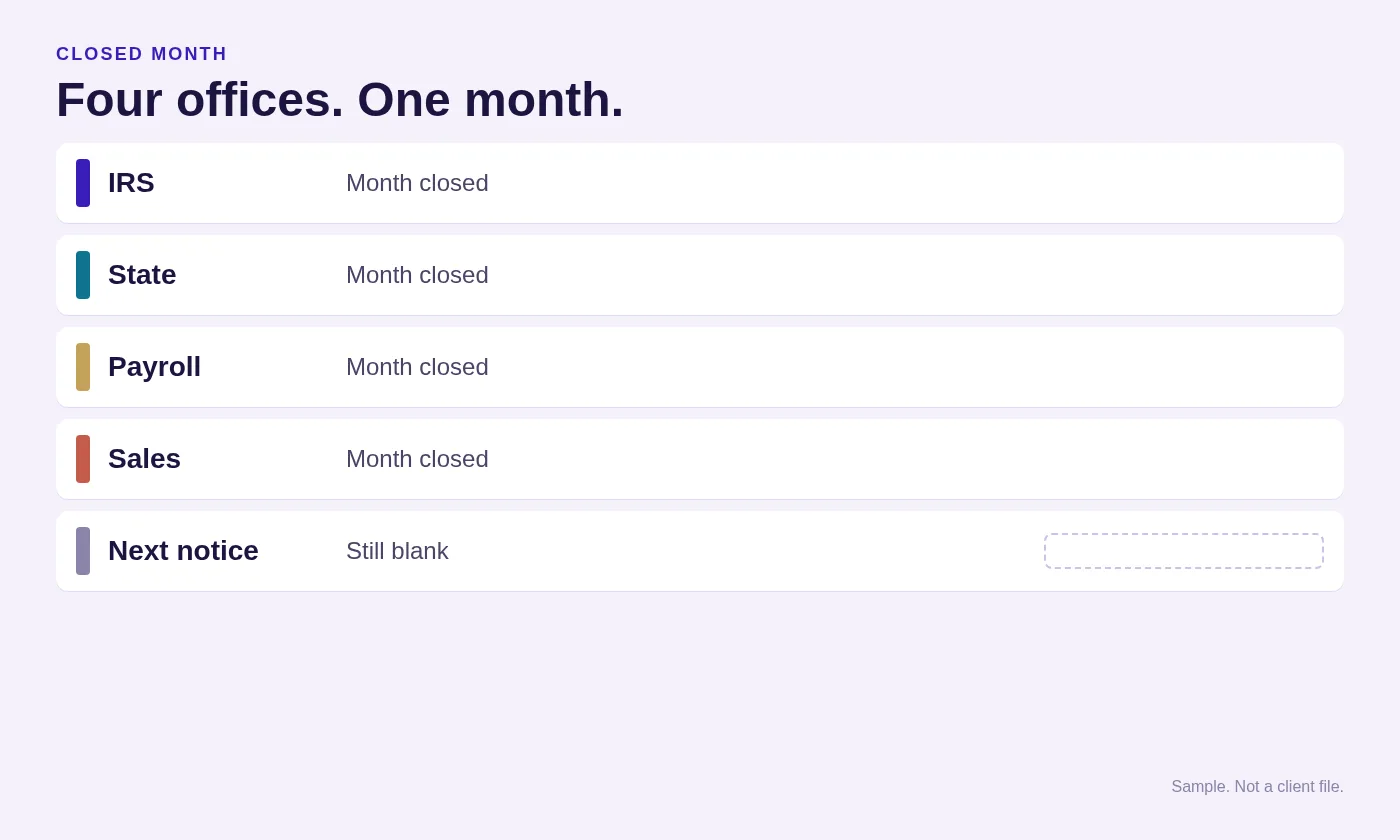
The count is the closed month. The decision is the next notice.
An accountant totals what already happened. A Tax CFO chooses which office gets an answer, and what the next month is allowed to do.

The federal form follows the election
The election picks the return, and the books still close first.
Click to see the federal form ›Tap to see the federal form ›
A state can still want a filing
A state report can stay open after the federal return.
Click to see the state filing ›Tap to see the state filing ›The company has to stay on the rolls
The certificate office wants the company to keep existing.
Click to see the company rolls ›Tap to see the company rolls ›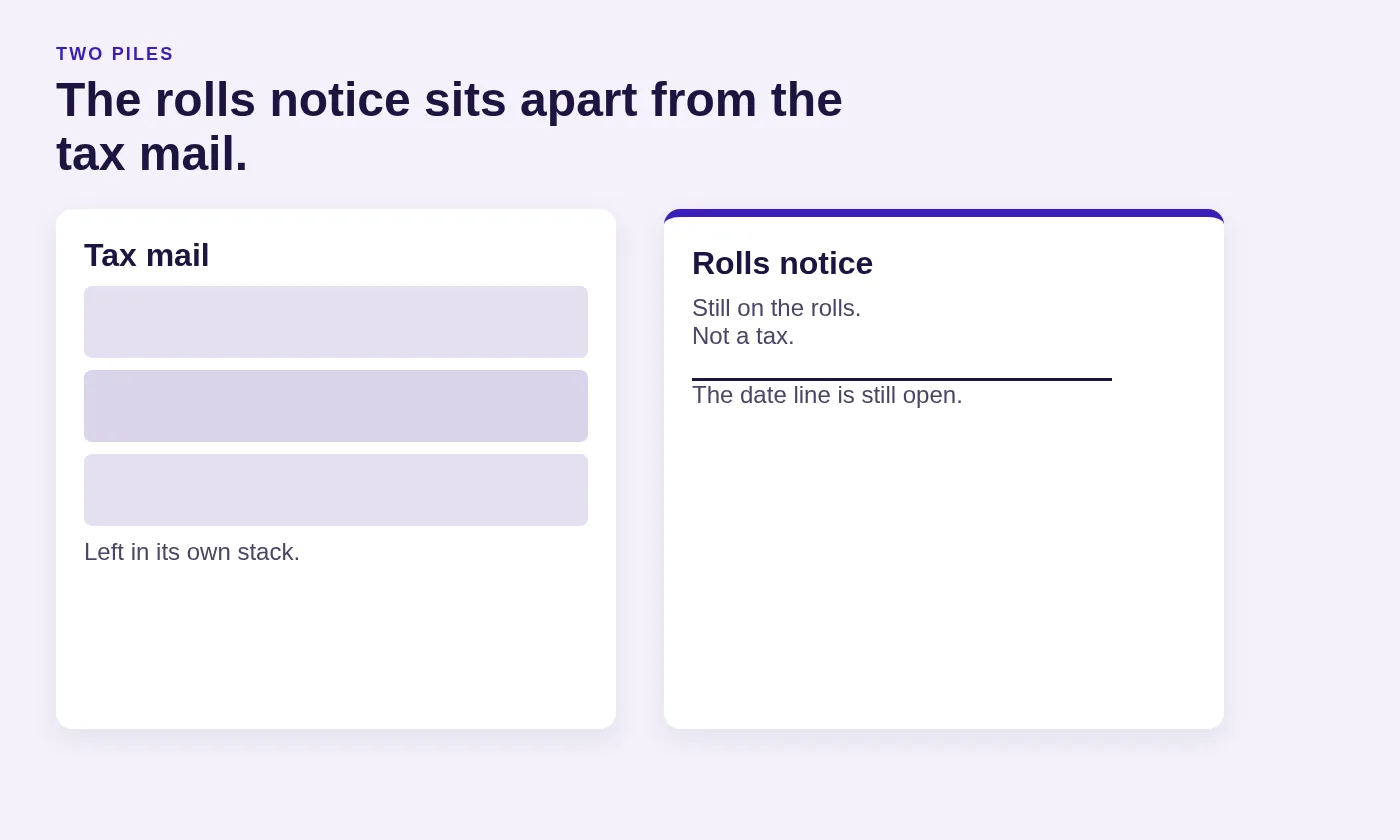
Payroll tax waits for wages
The first paycheck is when payroll tax enters the month.
Click to see payroll setup ›Tap to see payroll setup ›
Read the letterhead before the panic
Name the sender. Each page here is one sender.
Click to see a sorted notice ›Tap to see a sorted notice ›
A receipt is not a permit
A taxable sale can open a sales tax account.
Click to see when sales tax starts ›Tap to see when sales tax starts ›Six papers owners mix up.
Open one card. It names the office and the task.
1A notice with no clear sender
We read the letterhead before the body
The office named at the top is the calendar. The rest of the page is the task.
2The federal form changed after an election
We match the election to the books
A disregarded company, a partnership, and an S corporation do not file the same federal return.
3Wages started and the deposits did not
We set a payroll provider up in your name
Payroll tax appears when people are paid. Before wages, that account stays quiet.
4A shop receipt shows tax and you have no permit
We ask whether the sale was taxable
Forming a company does not by itself open a sales tax account.
5A state still wants a report after the IRS return
We keep that report on the same closed month
Finishing the federal return does not close a state filing with its own due day.
6The IRS login does not show the company
We look at whose return carries the activity
A disregarded company often lives on the owner's account, not on a separate business login.
The practice that does the close
The name on this card is Steven Palmieri, who works as a Tax CFO and as the Entrepreneur's CFO, and the job is the next notice.
Send the paper you are holding
Four offices, not one tax
People say business taxes as if it were one bill. On a company it is usually a pile. The IRS wants a return, and which return depends on an election already on file or one you still have to make. A state may want an income return, an annual report, or both, on a date the IRS does not use. A payroll agency appears only after wages exist. A sales tax office appears only if you sell something that office taxes.
The six tiles and the card of papers say the same thing at full length. A disregarded company, a partnership, an S corporation, and a C corporation do not share a return, and the books still have to be closed first. The federal return can be finished and a state report can still be open. The two calendars do not cancel each other. The office that issued the certificate wants the company to keep existing. That filing is not a tax return. No wages, no payroll account. The first paycheck is when deposits, forms, and a provider enter the month. Most scary mail gets shorter once the sender is named. The pages here are one sender each. Selling a taxable thing can create a sales tax account. Owning a company, by itself, does not. Open one card. It names who should touch that paper, and why the wrong office makes the month longer.
Steven Palmieri leads the close as a Tax CFO and as the Entrepreneur's CFO, and we keep the books, set payroll up on a provider you run, prepare the statements, and prepare the return the closed month supports.
Only the federal row moves when you file an election. The other rows keep their own forms. That is why a year can feel finished in April and still have a filing open in another login. We keep the four rows on one month so a change in wages, or in what the shop sells, gets checked against the return before the year locks.
If you only needed the name of the sender, you can stop there and file it yourself. The sort is the useful part. The engagement is optional.
What a closed month changes
A return built from a bank download and a guess is a story. A return built from a closed month is a set of numbers that already tie. Closing means the bank matches, the receipts have a home, the unpaid bills are listed, and payroll or contractor payments are in the right column. We do not prepare the return on top of an open month. Either that month gets closed, or the return is declined.
Owners feel the difference in October, when there is still time to decide a bonus, a retirement deposit, or whether an election is even on the table. By the time the notice arrives, the choice is smaller. The relief is a month that ends on a date you already know, with a short list of what is still open.
Statements are a product of that close, not a separate stack of guesses. A lender who wants a report with an auditor's signature is sent to a firm that can sign one. What we hand you is the month, the statements without that signature, and the return.
What we hand back
Send the notice and you get a short note. It names the office, the filing the page belongs to, what usually happens if it is late, and whether it is something you can handle yourself. Some of them genuinely are. A missing annual report on a company with no activity is not the same problem as a payroll deposit that never left the bank.
If you want the ongoing work, the month closes on a rhythm, payroll is set up in your name on a provider you run, and the return uses those numbers. We do not run the payday. If the paper needs someone to appear, we name whose job that is and stop. We will gather the records a hearing needs and say where representation has to go.
None of these pages is a calculation of your own tax. A rule that is true for a shop with employees is not true for a one person company with no wages. Bring the paper. We will not invent the figure the paper forgot to print.
A shop, a receipt, and a year still open
Picture a small shop. A customer pays. The receipt shows a tax line. The owner formed the company months ago and assumed the tax line was someone else's problem, or assumed the company itself created every account. Neither guess is safe. The receipt is a clue about sales tax. The formation paper is a clue about whether the company is still on the state rolls. The IRS notice, if there is one, is a clue about the election. Three clues, three logins.
We like the year while it is still open, because an open year can still take a decision. A closed year can only be explained. If the books have not been closed for a year, put that in the form. We would rather decline a messy pile at the start than pretend a weekend will make it a return.
Steven Palmieri and the people here do this by video, with the books shared. You do not mail the notice to a lobby. You do not need to be in any particular city for the month to close on the same day.